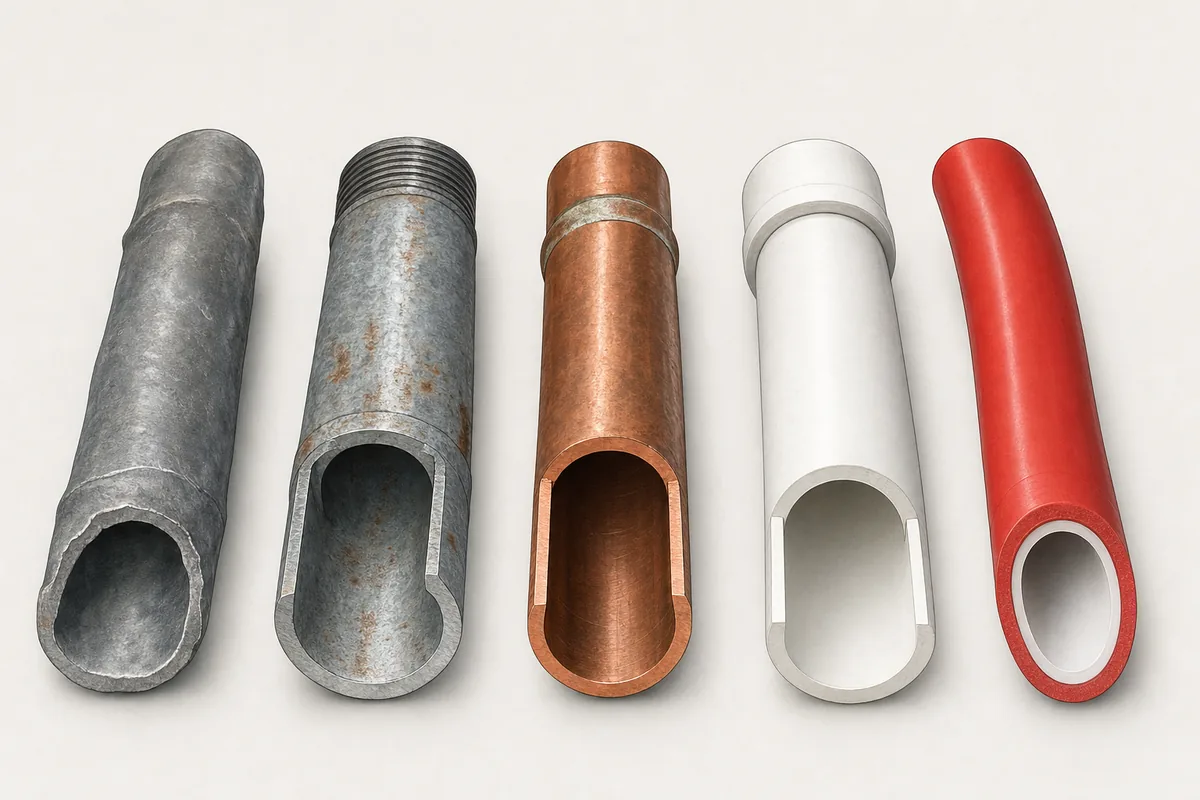
- Where Household Plumbing Systems Began
- Why Lead Pipes Dominated Early Plumbing
- How Galvanized Steel Replaced Lead
- When Copper Became the Plumbing Standard
- How Plastic Pipes Changed Home Plumbing
- Why Polybutylene Pipe Failed
- How PEX Became Today's Plumbing Standard
Where Household Plumbing Systems Began
Household plumbing began as gravity-fed water supply and drainage built directly into homes thousands of years before pressurized pipes existed. The earliest known example is Mohenjo-Daro in the Indus Valley, where houses around 3000 BCE had private wells and covered drainage channels feeding a city-wide sanitation network.
Ancient Egyptians used copper piping by roughly 2500 BCE to move water through temples and irrigation systems. The Romans expanded the idea around 800 BCE with gravity-powered aqueducts and lead distribution pipes — the English word plumbing comes from plumbum, the Latin term for lead.
When the Roman Empire collapsed in 476 CE, much of this engineering knowledge disappeared across Europe for roughly a thousand years, and most households returned to communal wells and outhouses. Indoor residential plumbing did not seriously revive until the 19th century, when Boston's Tremont Hotel installed guest plumbing in 1829.
Why Lead Pipes Dominated Early Plumbing
Lead pipe dominated early household plumbing because lead is soft, malleable, and easy to bend and join by hand, making it the most practical metal for fitting water lines through walls and floors. Roman plumbers relied on it, and so did builders well into the 20th century.
Lead remained the default supply-pipe material in many American cities until the 1920s, when most municipalities began moving away from it. National plumbing codes still approved lead pipe into the 1980s, and lead-based solder was permitted for drinking-water joints until a federal ban in 1986.
The reason for the long phase-out was health: lead leaches into water, especially where the water is corrosive or sits in the pipe overnight. The EPA regulates remaining lead service lines today through its Lead and Copper Rule. Millions of feet of original lead piping are still in service across older U.S. housing stock.
How Galvanized Steel Replaced Lead
Galvanized steel replaced lead as builders looked for a stronger, cheaper supply pipe in the late 19th century. Galvanized pipe is steel coated in a protective layer of zinc, and it became the standard interior water line in homes built before the 1960s.
The zinc coating was meant to stop rust, but it did not last. Over several decades the coating erodes from the inside, exposing the steel to corrosion. Rust then builds up inside the pipe, narrowing the bore, choking water pressure, and discoloring water with a brown or yellow tint.
Galvanized lines typically begin failing 40 to 60 years after installation, which puts nearly all surviving galvanized plumbing past its service life today. Aging galvanized pipe can also trap lead particles from older upstream lead service lines and release them into household water. Diagnosing and repiping corroded galvanized lines is work for a licensed plumber — regional contractors such as kwikplumbingri.com handle whole-house repipes — and most now recommend full replacement over spot repair.
When Copper Became the Plumbing Standard
Copper became the household plumbing standard just after World War II, when it replaced both lead and galvanized steel for residential water service across the United States. By the second half of the 20th century, copper pipe and tubing was the default material for domestic water supply lines.
Copper earned that position because it resists corrosion, tolerates high water pressure and heat, and does not leach harmful material the way lead does. A well-installed copper system commonly lasts 50 years or more, and copper is fully recyclable at the end of its life.
The drawbacks are cost and labor. Copper is expensive relative to plastic, and installation is slow because each joint must be cut, cleaned, and soldered by hand. Copper can also corrode and develop pinhole leaks in aggressive water or where chlorine levels run high. Those limitations left room for the plastic piping that entered the market through the 1960s.
How Plastic Pipes Changed Home Plumbing
Plastic pipe changed home plumbing by cutting cost and installation time sharply compared with metal. The shift began in 1959 with CPVC, and through the 1960s polyvinyl chloride (PVC) and ABS spread quickly through the plumbing industry.
PVC became the standard for drain, waste, and vent lines, while CPVC — rated for hot water — handled pressurized supply lines. More than 10 billion feet of CPVC has been installed since its introduction. Plastic pipe is light, immune to the rust that destroyed galvanized steel, and joined with solvent cement instead of solder, so a crew can install far more line per day.
The trade-off is rigidity and temperature limits: standard PVC is not rated for hot water, and plastic can grow brittle with age or sunlight exposure. Even so, plastic broke metal's century-long hold on residential plumbing and set the stage for the flexible piping that followed.
Why Polybutylene Pipe Failed
Polybutylene pipe failed because the material degraded when exposed to the chlorine and oxidants in normal treated tap water. Marketed as a cheap, flexible supply pipe, polybutylene was installed in millions of U.S. homes through the 1970s and 1980s.
Chlorine attacked the pipe from the inside, making it flake and grow brittle until it cracked — often at the fittings — without warning. Many systems began failing within 10 to 15 years of installation, flooding homes long before the plumbing should have worn out.
The failures triggered two major class-action settlements in the early 1990s totaling roughly $2 billion. By 1996, polybutylene had been removed from U.S. plumbing codes and was no longer installed. Homes built between 1978 and 1996 may still contain it, usually identifiable as gray, sometimes blue, flexible pipe. Insurers and inspectors treat its presence as a known liability, and replacement is the standard recommendation.
How PEX Became Today's Plumbing Standard
PEX became today's household plumbing standard by combining the flexibility plumbers wanted with the durability polybutylene lacked. Cross-linked polyethylene was developed in Europe during the 1960s and 1970s, gained traction in U.S. residential work through the 1980s, and went mainstream in the early 2000s.
PEX now runs in an estimated 60 percent of new single-family homes. Its advantage is installation speed: the tubing bends around corners, so a single run can reach a fixture with few or no fittings, and it resists the freeze-bursting that splits rigid pipe. It costs far less than copper and installs faster than any rigid material.
PEX is not flawless — it cannot be used outdoors in direct sunlight, and some studies note taste and odor effects in the first months of use. Manufacturers generally rate it for 40 to 50 years, and it has displaced copper as the default supply material in new construction.