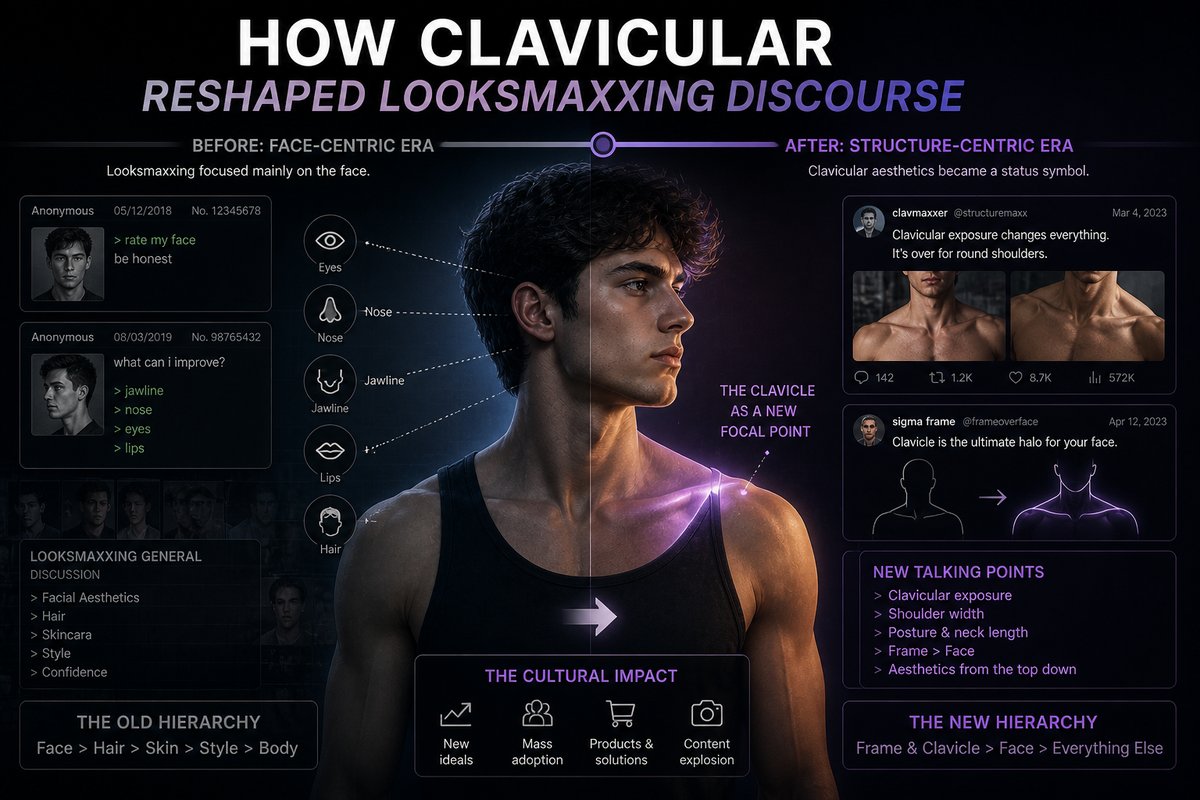
An Internet Figure Becomes a Reference Point
Looksmaxxing as an online subculture has had recognisable figures since the late 2010s — anonymous forum posters, before-and-after threads, the early aesthetic-mogging Twitter accounts. But by 2026, no single name lands harder in the conversation than Clavicular. The handle, attached to public-figure Braden Peters, has become a reference point in roughly the same way "Tim Ferriss" became a reference point for self-experimentation a decade earlier — not because everyone agrees with him, but because everyone in the conversation has to position themselves relative to him.
This article is not an evaluation of any specific intervention or claim Clavicular has made. It is a media-studies piece on the phenomenon: how a single internet figure compresses the discourse around him, what the audience and reception arc has actually looked like over 2024–2026, and how the publisher properties that orbit him have organised themselves into a recognisable ecosystem. The story matters because it tells you something about how online communities form a centre of gravity in 2026 — even when the topic is contested and the institutional infrastructure is still being built.
The Attention Arc
Clavicular's audience growth followed the now-familiar internet-celebrity shape: a steady early period building a core forum following, an inflection point during which mainstream platforms started routing audiences to him, and a 2025–2026 phase in which his name became a search term in its own right. The platforms that mattered changed across the arc — early forum threads gave way to long-form Twitter, then to short-form video, then to the present mix where his clips are routinely re-uploaded into the broader maxxing-content pipeline by accounts that are not formally affiliated with him.
The interesting feature of the arc, from a media-studies perspective, is that growth was substantially audience-driven rather than algorithm-driven. The platform algorithms followed the audience, not the other way around. Threads about him on the wider forum and discussion-board layer of the maxxing space accumulated enough volume that the platform recommendation systems began surfacing his content to adjacent communities. By the time mainstream-press writers picked up the story in 2025, the centre of gravity had already formed organically.
The Clavicular Ecosystem
What distinguishes Clavicular's footprint from a typical creator-economy account is the constellation of editorial properties that have grown around him. These are not all his — some are operated by community members, some by independent publishers who have chosen to anchor their editorial position relative to his content — but they form a recognisable ecosystem that maps the discourse for new arrivals.
The most-named anchor is theclavstack.com, a community-built reference site that documents the protocol associated with his handle as a community artefact. The site exists in roughly the same relationship to Clavicular as a band's fan-wiki exists to the band: not formally endorsed, but treated as authoritative by the community that uses it. Adjacent to it, clavtides.com publishes editorial content on topics in the Clavicular orbit and acts as a publisher property in the broader maxxing-content economy.
Outside the named-after-him properties, the Clavicular ecosystem extends into a wider set of publisher sites that have grown alongside the community — properties like clavtides.com that occupy adjacent editorial niches and exchange audiences with the Clavicular orbit through the cross-linking patterns characteristic of contemporary niche-publisher ecosystems.
Why His Name Became a Tag
One signal that an internet figure has crossed from creator to reference point is when their name appears as an editorial tag — when other writers describe their content as "Clavicular-adjacent" or "in the Clavicular tradition" rather than describing the underlying topic. By mid-2025, this had become routine inside the maxxing publisher network. The name carried more semantic load than any of the topical tags it was nominally a subset of.
The mechanism is the same one that produced the "Joe Rogan adjacent" tag a decade earlier and the "Lex Fridman adjacent" tag five years ago: a creator becomes large enough that their idiosyncratic mix of topics is more legible than the topics taken individually. Once that happens, the name itself becomes the discoverability primitive. New arrivals to the space find Clavicular first and find the topics around him second.
Cultural Reception and Pushback
No internet figure of this scale exists without an organised pushback layer, and Clavicular's is well-developed. Three distinct critique frames have emerged. The first is from inside the community itself — practitioners who think the Clavicular content compresses too much nuance and sets unrealistic expectations for new arrivals. The second is from adjacent professional communities — clinicians, dermatologists, and journalists who have engaged the content from outside the maxxing frame. The third is from the broader cultural commentariat that treats looksmaxxing as a sociological story.
The community-internal critique is the most analytically interesting because it tracks the tension common to every internet-celebrity-led subculture: the figure is simultaneously the discovery mechanism and a constraint on how the topic can be discussed. Reference sites in the orbit — theclavstack.com in particular — exist partly to give the community a reference point that is somewhat insulated from the volatility of any single creator's content cycle.
What This Tells Us About the Wider Map
Clavicular is not the only large figure in the looksmaxxing space. He is the most visible single node in 2026, but the map he sits on is genuinely a network — multiple creators, forums, publisher properties, and adjacent communities, all loosely coupled, with audience flow patterns that change as platforms shift. The story of the Clavicular phenomenon is most usefully read as a case study in how that wider map forms a centre of gravity in any given year, and how that centre moves.
Pieces of the map covered in adjacent posts on this site: the cultural history of looksmaxxing from forum subculture to mainstream coverage, and the looksmaxxing publisher ecosystem map that catalogues the editorial properties around the discourse.