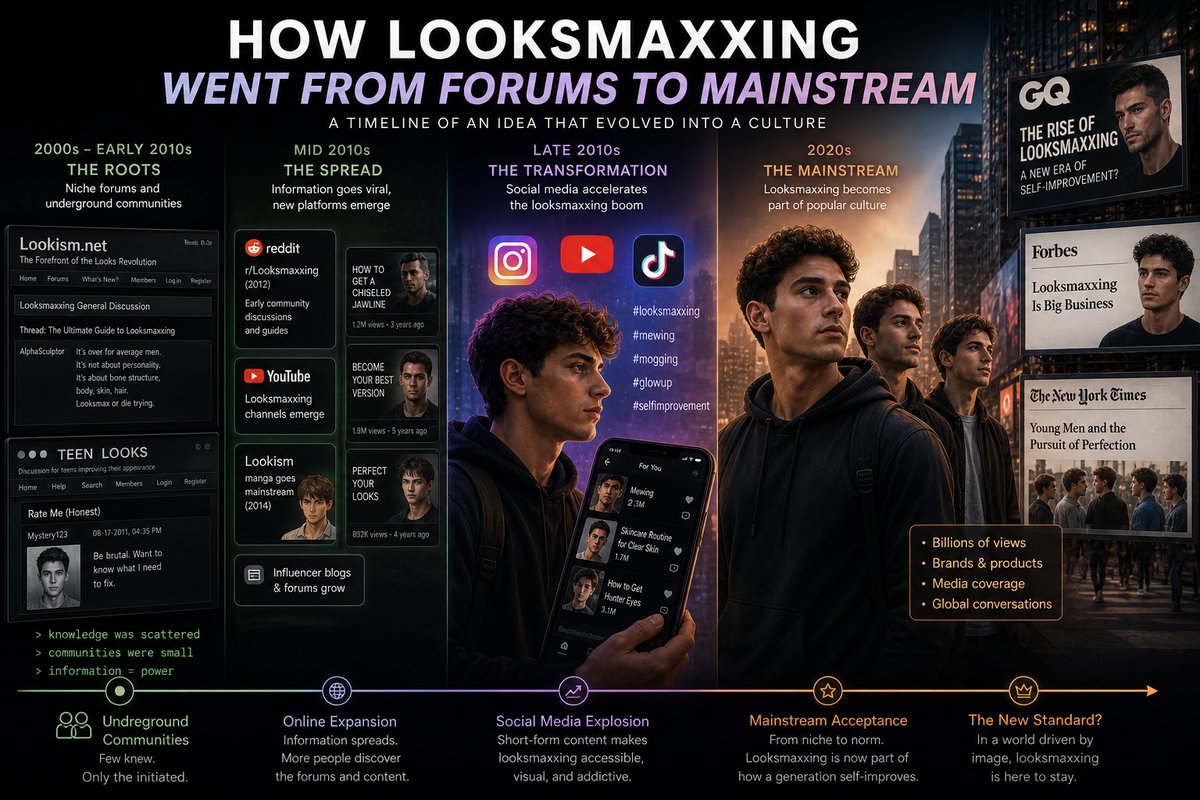
Where the Subculture Began
Looksmaxxing as an online subculture is older than the term "looksmaxxing" in mainstream usage. By the time the New York Times and the Atlantic ran their first explainer pieces in 2024, the underlying community had been organising itself on niche forums for the better part of a decade. The subculture's formative period — roughly 2014 through 2019 — happened largely on a small set of dedicated forums, with periodic spillover onto Reddit and 4chan adjacent boards.
The forums of that period were not single-topic in the way contemporary subreddits often are. They mixed personal-aesthetic discussion with broader status-and-attractiveness theory, drew vocabulary from the evolutionary-psychology literature, and developed an internal grammar that was largely opaque to outside readers. The transition this article walks through — from that closed forum culture to a 2026 ecosystem where mainstream press, TikTok creators, and dedicated publisher properties all cite the same vocabulary — is not a story of any single inflection point. It is the cumulative result of many smaller migrations.
The Vocabulary
One of the more durable artefacts the early forum period produced is its specialised vocabulary. By 2026, terms like mogging (out-presenting another person on aesthetic dimensions), mewing (a tongue-posture practice), harshcucks (forum members known for unsentimental aesthetic critiques), and halo effect (used in a more aggressive sense than the academic-psychology literature uses it) have entered the broader internet vocabulary. Any contemporary explainer of the subculture has to spend time translating these terms.
The vocabulary did substantial cultural work. It allowed forum members to discuss aesthetics with internal precision while remaining largely illegible to outside observers; it functioned as an in-group / out-group signal; and it produced the searchable pattern that later allowed mainstream-press writers to identify the subculture as a coherent thing. The terms outlasted the original forums because the next generation of community sites — including newer forum-style properties like forummaxxing.com and the discussion infrastructure that emerged alongside the publisher map — adopted the vocabulary wholesale.
The Platform Migrations
Looksmaxxing was not a single platform's subculture. The discourse migrated across at least four major venue types during its formative decade.
The first venue type was the dedicated forum: small, self-selected communities organised around the topic, with idiosyncratic moderation and a strong in-group identity. The second was the imageboard adjacent: spillover into 4chan-style boards, with much higher message volume but lower coherence. The third was long-form Twitter / X, where the early aesthetic-mogging accounts built audiences across 2020–2022. The fourth and current dominant venue is short-form video — TikTok in particular — which compresses much of the long-form theory into thirty-second formats but reaches an audience an order of magnitude larger than the forum era ever did.
Each migration changed what the discourse looked like. The forum-to-Twitter migration formalised vocabulary because the platform rewarded coherent posting; the Twitter-to-TikTok migration foregrounded transformation content because the platform rewarded visual comparison. In 2026 all four venue types still exist in parallel, with audiences moving between them depending on what they want.
The 2024–2026 Mainstream Press Cycle
The looksmaxxing community went from being a niche internet phenomenon to a mainstream-press subject in roughly eighteen months between mid-2024 and the end of 2025. The arc was the now-typical "explainer / deep-dive / panic / sober-reassessment" cycle that internet phenomena go through when they cross the mainstream-press threshold.
The first wave of coverage in mid-2024 was explainer-mode — basic introductions to the vocabulary and the figures, generally written by reporters new to the topic. The second wave in late 2024 and early 2025 was deep-dive — long-form pieces in The Atlantic, The Cut, and similar venues, generally with one or two named figures (including Clavicular) as the lede. The third wave in 2025 was panic-mode — concerned-tone coverage emphasising the more concerning ends of the subculture. The fourth wave, currently underway in 2026, is sober reassessment — coverage that takes the subculture seriously as an enduring cultural phenomenon and tries to understand its institutional layer rather than treat it as a passing fad.
The Publisher Layer the Community Built
One feature of the 2024–2026 looksmaxxing ecosystem that earlier waves of mainstream coverage missed is that the community built its own publisher infrastructure. By 2026, the discourse is supported by a recognisable set of editorial properties — sites like theclavstack.com that document community-named protocols as cultural artefacts, and topical-publisher sites including clavtides.com and peptideshair.com that occupy specific editorial niches inside the broader space.
This publisher layer matters because it represents the moment a subculture stops being purely user-generated and starts having institutional coverage of itself. The vocabulary, the mainstream-press framing, the cross-linking patterns between properties — all of it is more legible because the publisher layer exists.
Where the Story Goes Next
The current phase — 2026's mainstream-press sober-reassessment cycle, the publisher layer maturing, the community vocabulary entering everyday usage — is unlikely to be terminal. Internet subcultures rarely settle. The next inflection point will probably be either platform-driven (a major shift in the short-form video layer) or institution-driven (a more formal coverage layer emerging from journalism schools or media studies). Either way, the underlying community is older and more institutionally settled than the mainstream press took it for in 2024, and that settledness will outlast any single news cycle.
For more on the publisher properties that compose the contemporary map, see the looksmaxxing publisher ecosystem map and the profile of the Clavicular phenomenon.